10,000 Products (No Images)
Deterministic repeat, WebToffee Free 2.6.5: 886.904 seconds for the 10,000-product initial import with a batch size of 100. During the run, CPU averaged 27.60%, RAM averaged 1,136.9 MiB and disk activity averaged 6.23%. After subtracting the measured baseline, the complete job used 14.2561 vCPU-minutes, 55.222 seconds of disk-busy time and 473.780 MiB of writes. The repeat ran on WordPress 7.0.3 and WooCommerce 11.0.0, as stated on the comparison page. Inspect the measured result. The earlier recorded run remains below as separate evidence.
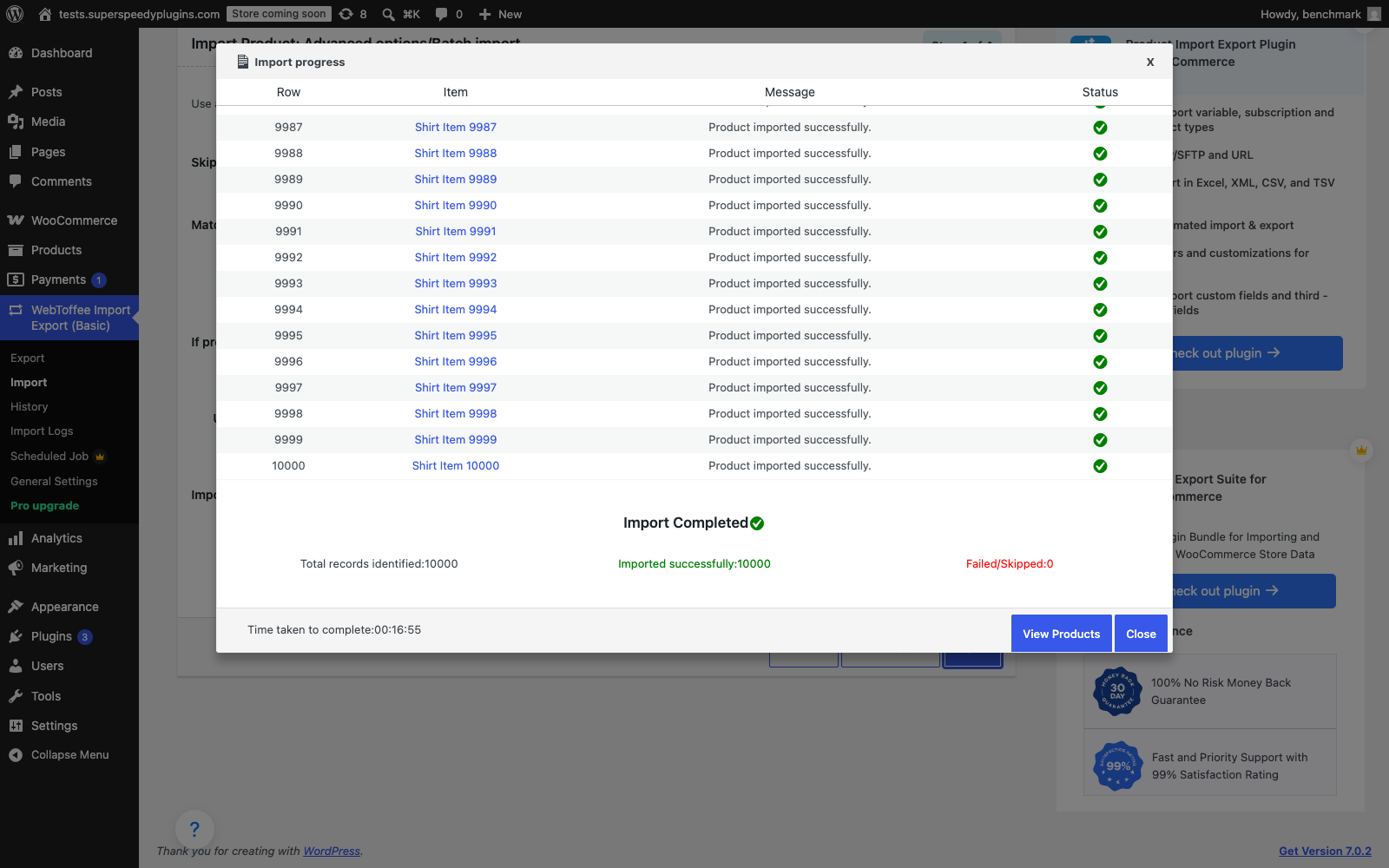
Earlier run, compared with Super Speedy Imports Pro 2.83.0: WebToffee Free 2.6.5 imported 10,000 simple WooCommerce products in 1,016.141 seconds, measured from the browser immediately before starting the import until its completion screen appeared. The plugin reported 1,015 seconds.
Earlier run summary
| Metric | Earlier run, compared with Super Speedy Imports Pro 2.83.0 |
|---|---|
| Browser wall time | 1,016.141 s (16m 56.141s) |
| Plugin-reported time | 1,015 s |
| Throughput | 9.841 feed rows/s |
| Published products | 10,000 |
| Correctness | Passed measured field, taxonomy, attribute and SKU checks |
| Compared with SSI | SSI Pro 2.83.0 completed the identical feed in 15.947 s, 63.719× faster |
See the Super Speedy Imports result or the direct comparison.
Dataset and configuration
- Initial feed: 10,000 simple products, 2,644,851 bytes, SHA-256
cd135ff65a4b15a717bc3057a7980f0b42b4d14e08c994541e25d54f90a3f64e. - Update feed: 10,000 rows, 2,816,718 bytes, SHA-256
43df664ec47e188443b6fbb4e978808c37c52f6935865ff1d95df9b47ca85b26. - Update changes: 2,500 existing products changed, 1,000 products added, 1,000 original products omitted, and 6,500 retained products unchanged.
- Mapped data: title, descriptions, SKU, regular and sale prices, weight, category, brand, global colour and global size.
- Edition: official WordPress.org package, Product Import Export for WooCommerce Free 2.6.5.
- Package SHA-256:
09d2dfc17c2e091b0377c4b8a5869e701071e24625d02f4c8d75c12035105f23b. - Matching: SKU, with existing matches configured to update.
- Batch size: 100, increased from the default 10.
- Mapping: 13 required product fields mapped explicitly.
- Requests (earlier run): 100 sequential import batches plus one download request, all HTTP 200.
Environment (earlier run)
| Component | Value |
|---|---|
| Server | Hetzner benchmark VPS, 4 vCPU, 8,121,954,304 bytes RAM |
| Stack | PHP 8.2.33, MariaDB 10.11.18, WooCommerce 10.3.8 |
| Isolation | Hetzner snapshot 390805640 restored before each plugin |
| Dataset | The exact same CSV bytes were supplied to both plugins |
| Images | None, so the test isolates CSV parsing and WooCommerce data writes |
Correctness
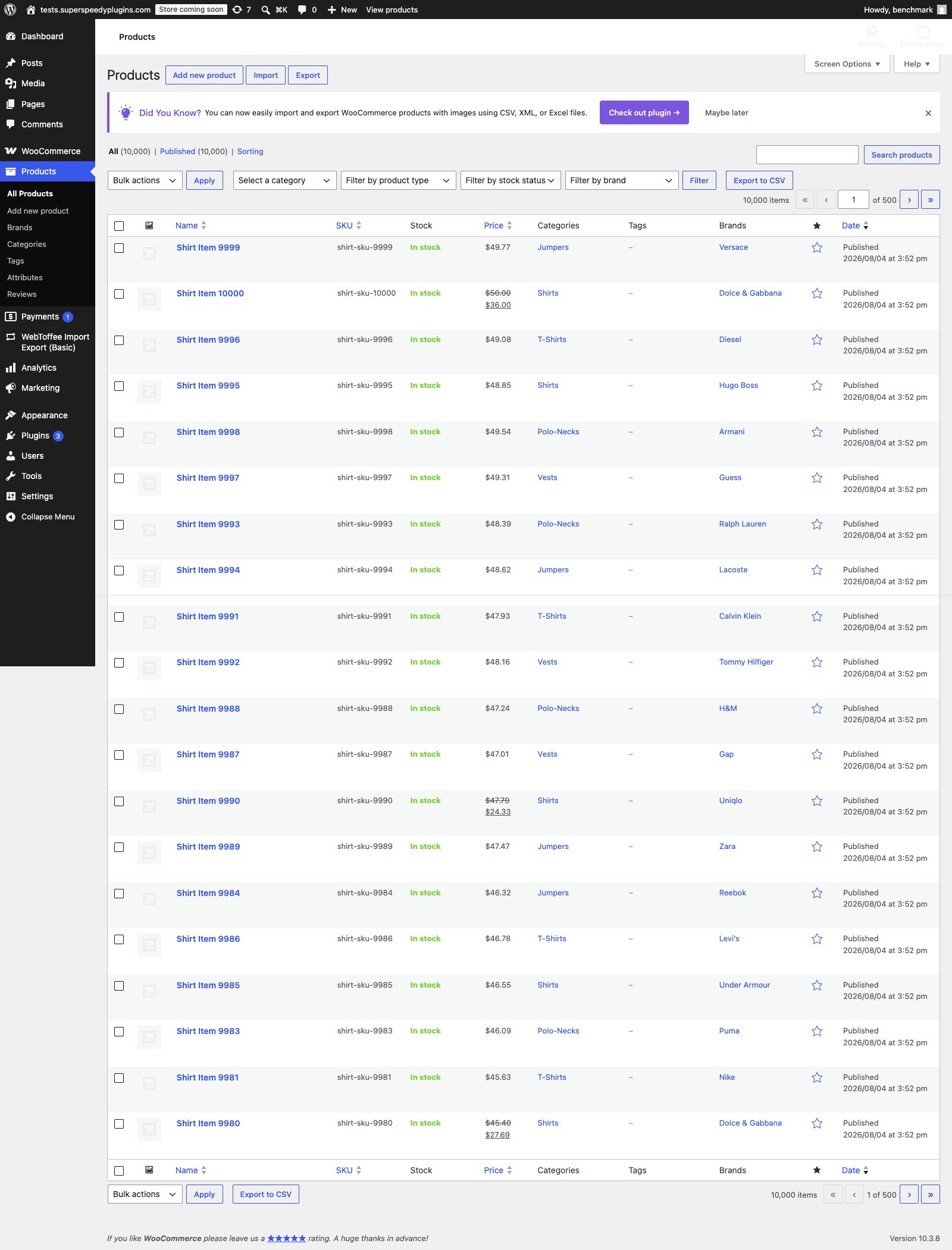
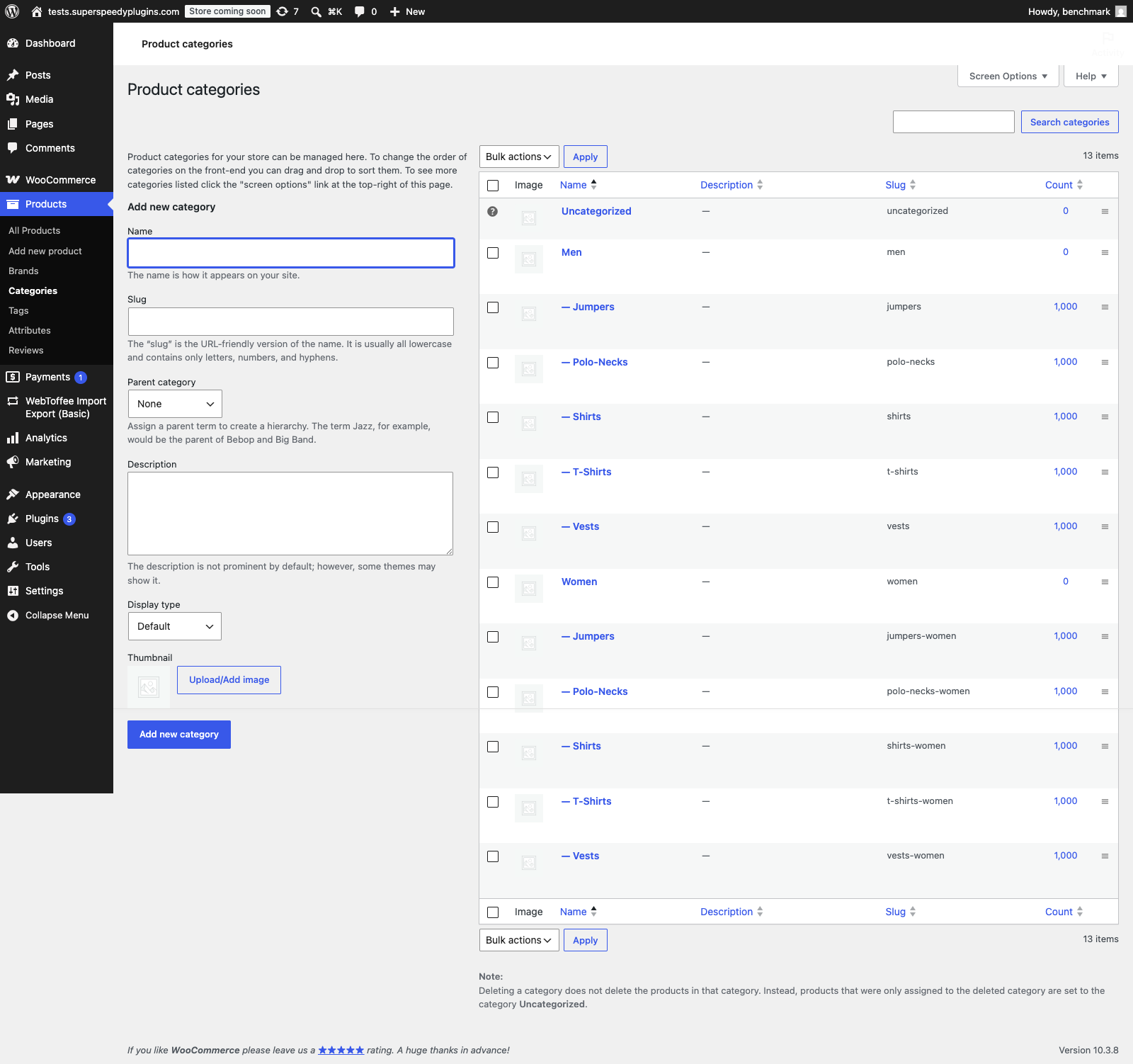
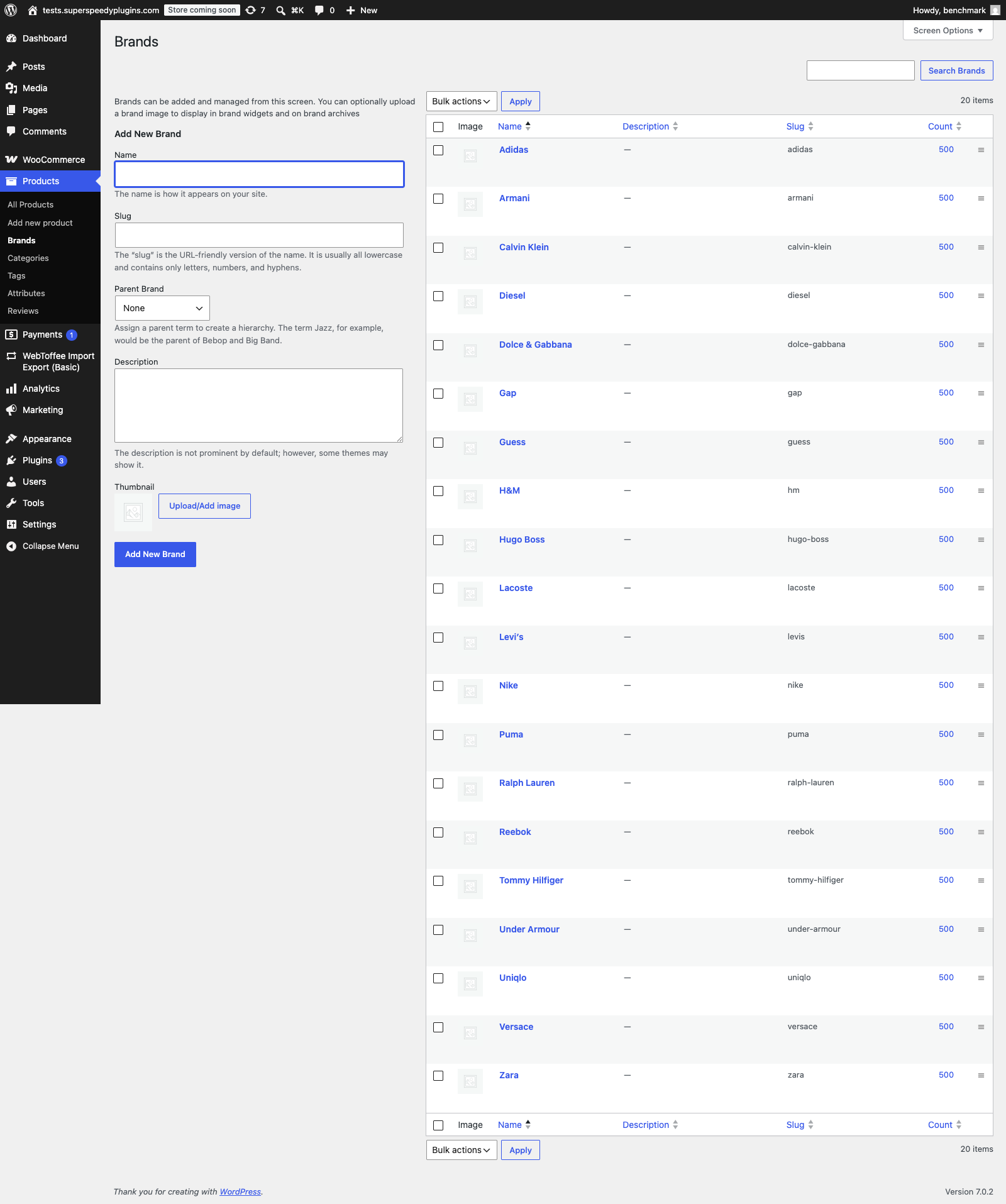
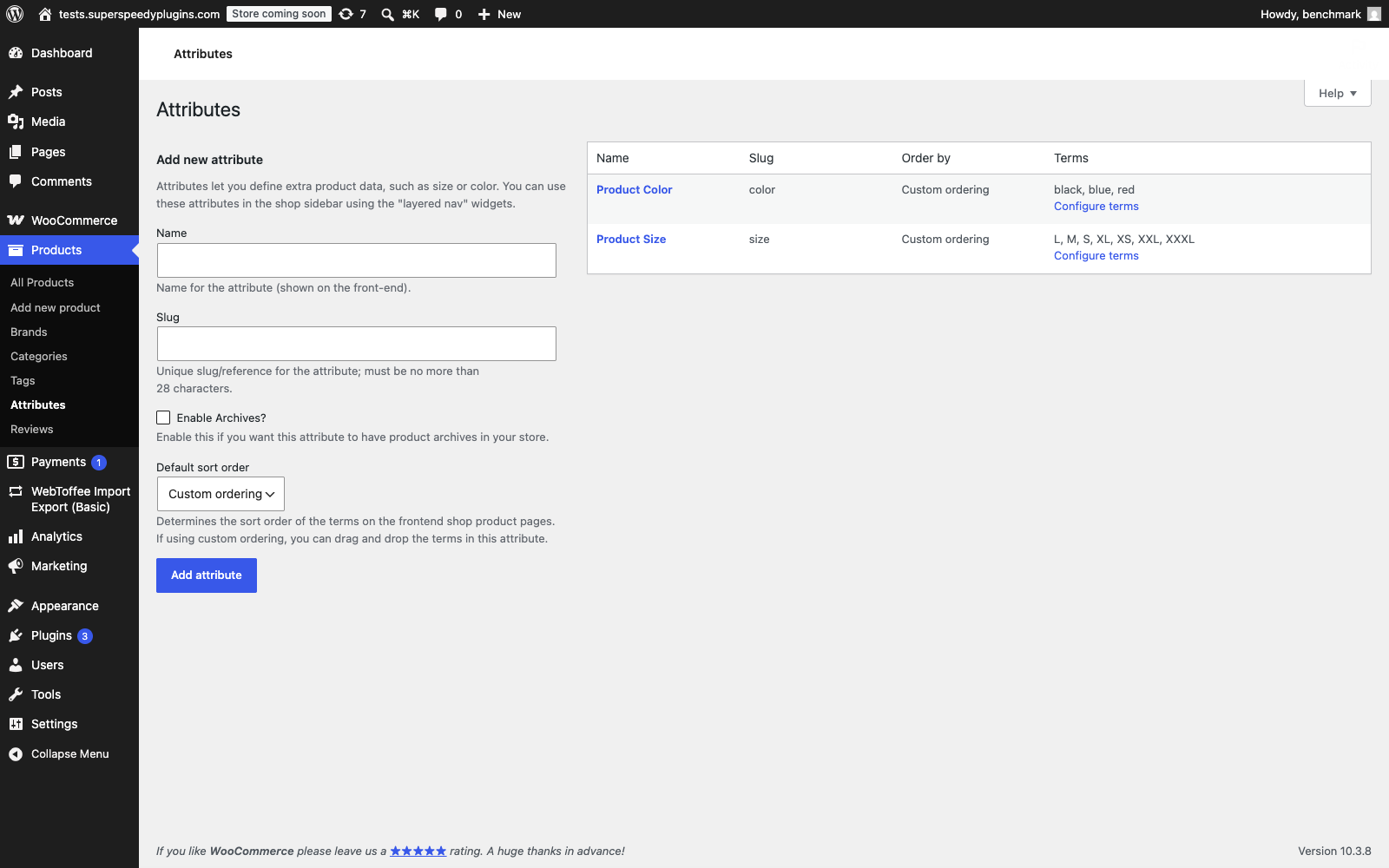
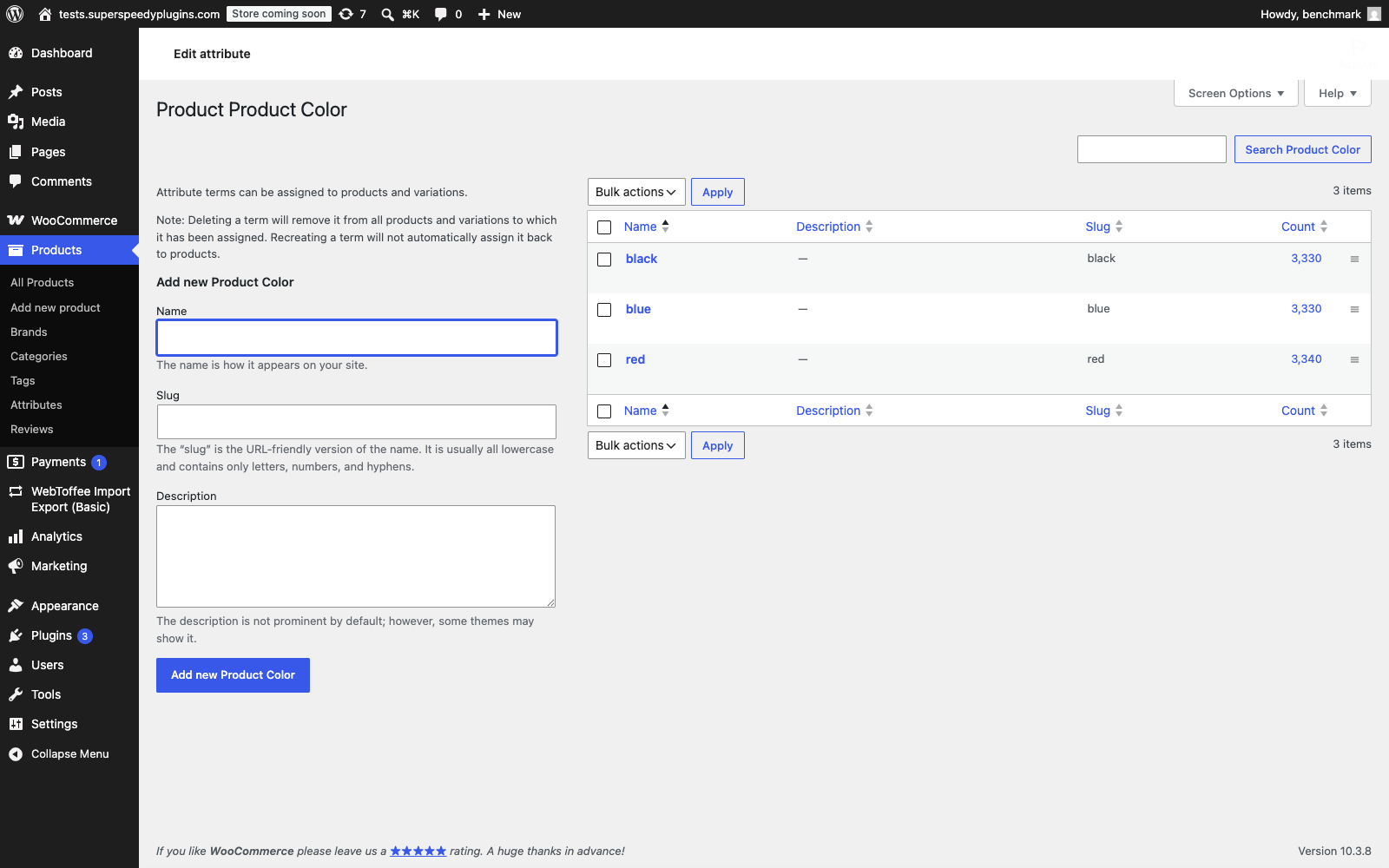
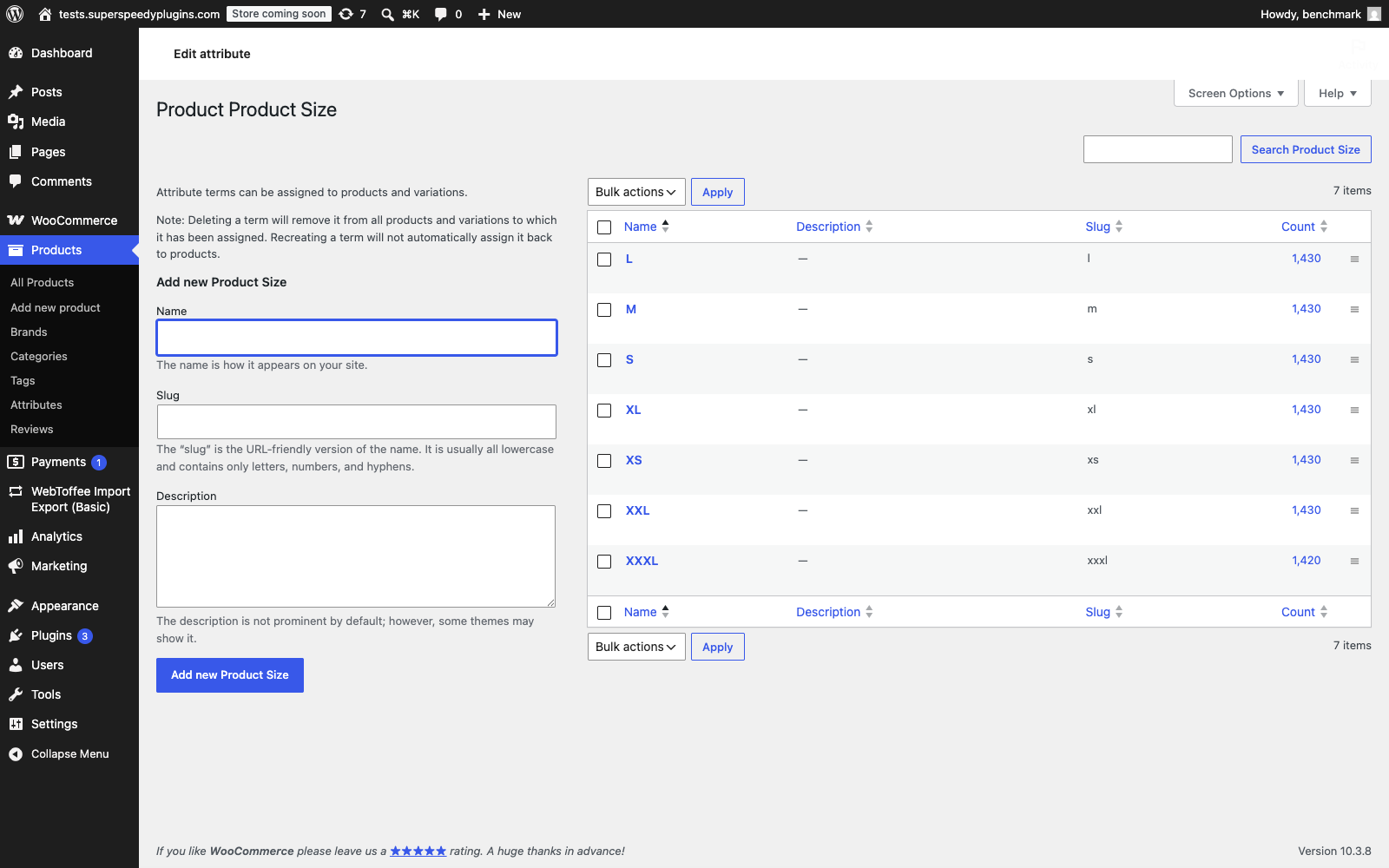
The finished catalogue contained 10,000 unique published SKUs. All 10,000 products had both global attributes and relationships to product category, product brand, colour and size. The screenshots below are benchmark evidence, not illustrative examples.
Post-import catalogue evidence
These screenshots were taken in the earlier run, immediately after the plugin reported completion. They show the WooCommerce product total, category and brand counts, global attributes, and the colour and size term counts.
Reproduce
Download the reproduction bundle, including the exact CSV, manifest, SHA-256 hashes, capture metadata and sar telemetry.
Caveats
The earlier run’s figure is browser wall time because that covers the complete user-visible operation. In the earlier run, a test-site-only nginx rate-limit bypass was present, but it was non-binding: the batches were sequential, no more than one started in any second, and every response returned HTTP 200. The bypass was removed after the benchmark. This is a controlled result, not a promise of identical timing on every host.

Comments