Cache Everything for Everyone

Dave sets up full-page caching on your WooCommerce store so every visitor gets cached pages, not only anonymous ones.

  • Logged-in customers get cached shop, category and product pages.
  • Shoppers with items in their basket do too, and still see their own prices, stock and basket.
  • Done for you within seven calendar days once access and an accurate staging copy are verified.
  • Baseline measurements before the work, verified cache checks after launch.
  • A fixed price of €1,450 excluding VAT where applicable, with three months of support for faults in the delivered work.

Cache everything, for everyone

Dave sets up full-page caching so eligible shop and content pages come from cache for anonymous visitors, logged-in customers and shoppers with a basket. Each visitor still sees their own prices, stock and basket.

Most WordPress caching tools bypass a page as soon as they see a logged-in cookie or an active basket. That protects correctness, but it also leaves some of the store’s most valuable visitors waiting for PHP, WordPress and WooCommerce on every page view.

Cache Everything for Everyone changes that safely. Eligible catalogue and content pages can remain fully cached while each visitor’s prices, stock and basket state are loaded through a per-visitor AJAX request. Other personal areas, such as wishlists, account names, loyalty balances and customer-specific notices, are identified during the survey and either loaded separately or kept outside the shared cache. The separate Cart/Basket, Checkout, My Account and any other page that shows private information stay outside the shared cache.

€1,450
fixed price, excluding VAT where applicable
7 calendar days
delivery after the store is accepted and access and staging are verified
1 store
one accepted WooCommerce site per implementation
3 months
support for faults in the delivered implementation

What the implementation delivers

The aim is not simply a better test score. It is correct, cacheable WooCommerce pages for real customers with real baskets. Eligible shop, product and archive pages can be returned quickly from full-page cache before that visitor’s prices, stock and basket information are loaded separately. The live proof below shows the measured result.

Full-page cache for eligible pages
Home, shop, category, product and other shared content pages can be served from full-page cache to logged-in visitors and visitors carrying a basket.
Personal basket state restored
Basket counts, mini-carts and other visitor-specific parts of the page are identified and loaded separately without making the whole page private.
Customer-specific data restored
The site is configured to load the correct per-visitor prices, stock and agreed personal parts of the page through per-visitor AJAX requests.
Safety checks before launch
The implementation is tested on staging, checked across guest and customer states, and deployed with a tested rollback procedure.
Safe shared caching
Only a safe, non-personal version is stored as the shared page. Personal responses are blocked from replacing it.
Evidence and handover
The client receives a concise record of what changed, which pages remain uncached, the measured cache checks and how to verify that the result remains correct.

Live demo

See the basket-holder experience and a measured full-page cache response.

Visit the Super Speedy Plugins page, add any plugin to your basket, then carry on browsing the shop. No checkout is required. Eligible shop, category and product pages will still come from full-page cache while your basket count, prices, stock and other personal details are loaded separately.
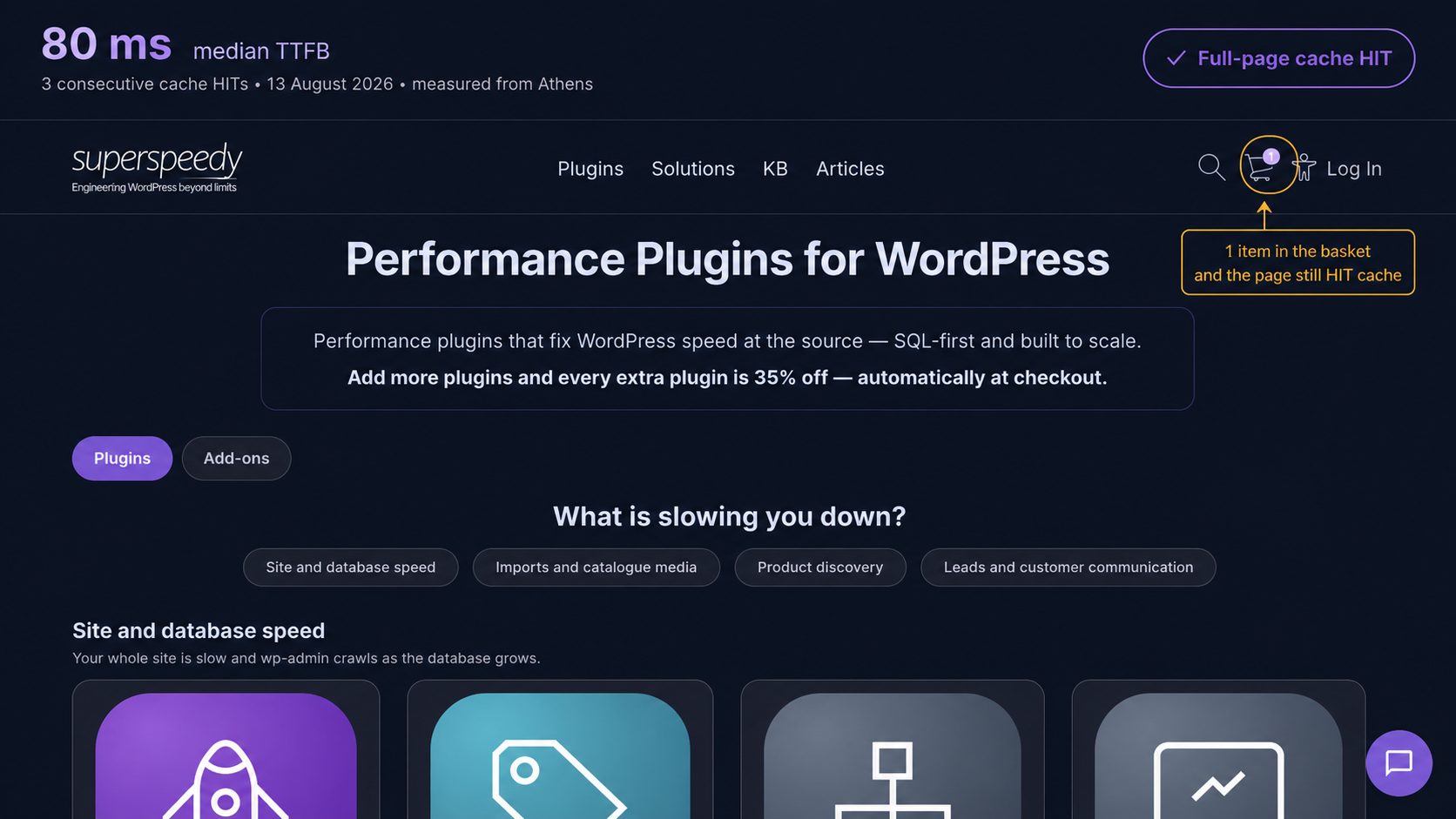
Figure 1 – Basket-holder cache HITSuper Speedy Plugins page served from full-page cache with one item in the basket
Exhibit A: One item in the basket, and the catalogue page still came from full-page cache.
Measured cache proof
On Dave’s own store, a shopper with an item in their basket got cached pages with an 80 ms median time to first byte (3 requests, measured 13 August 2026). All three were verified cache HITs. That’s Dave’s own site measured from Athens. A cached page’s time to first byte depends mainly on the speed of the cache service and where the visitor’s computer is, so Dave measures your store before and after rather than quoting you his.

Cache Everything for Everyone, implemented within seven calendar days

The delivery window begins after Dave accepts the store and verifies the required access and a staging copy that accurately matches the live store.

From survey to safe launch

Accept the store and verify access
Before purchase, Dave checks that the store is suitable. WordPress, staging, hosting, cache and CDN access are verified before the seven-calendar-day delivery window begins.
Map every source of personalisation
Dave reviews the theme, complete plugin list, must-use and host plugins, Code Snippets, child-theme customisations, cookies, pricing rules, stock behaviour, basket areas and private pages.
Build and test on staging
Caching and per-visitor updates are implemented on staging, then tested as a guest, a logged-in customer and a customer carrying basket contents.
Roll out safely
The proven setup is deployed to production with targeted checks, cache inspection and a tested rollback procedure.
Hand over the evidence
The client receives the implementation notes, exclusions, verification steps and the start date for three months of support.

What is included

A complete implementation for one accepted WooCommerce site, sold as a fixed-price service.

  • Technical survey and personalisation map for one WooCommerce site.
  • Review of the complete plugin list, must-use and host plugins, Code Snippets and relevant child-theme customisations.
  • Baseline measurements and cache-behaviour checks.
  • Store-specific compatibility code in the separate consultancy plugin where required.
  • Staging implementation and state-based correctness testing.
  • Production deployment and immediate post-launch verification.
  • A concise handover covering changes, exclusions and verification steps.
  • Three months of support for faults in the work delivered under this engagement.

Why this is consultancy rather than a one-click plugin

Every WooCommerce store has a different personalisation surface, and getting it wrong can expose one visitor’s information to another.

Dave first scans the theme, active plugins, must-use plugins, host plugins, Code Snippets and child-theme customisations to find everything that changes by login state, customer, country, role or basket. That includes pricing, stock, menus, wishlists, loyalty balances, side baskets, recently viewed products, customer-specific notices and cookies set while a page is being generated.

Where a theme or plugin outputs personal information into a cacheable page, Dave adds store-specific compatibility code inside a separate consultancy plugin. That code can load personal output after the cached page arrives, keep a genuinely private page outside the shared cache, defer a cookie to a per-visitor request or configure the cache around a real exception.

The resulting setup is tested as a guest, a logged-in customer and a customer carrying a basket before it is allowed to go live. A mass-market plugin cannot safely guess these details across every possible WordPress stack, which is why this is a fixed-scope implementation service rather than a one-click setting.

Your private pages stay private

Cart, Checkout, My Account and other pages containing private information are never shared between visitors.

This refers to the separate Cart/Basket page, not to browsing after an item has been added. Eligible shop, category, product and content pages can still come from full-page cache for a visitor carrying a basket. Side baskets, mini-carts and fast-cart panels are personal parts of the page and are loaded separately. Product filters, searches, currency selectors and other options that genuinely change the requested content also stay uncached. Normal Facebook, Google, email and other tracking links do not stop an otherwise eligible page being cached.

Caching systems supported by the implementation

The method works with common WordPress, server and Cloudflare page caches.

Supported systems include WP Rocket, W3 Total Cache, LiteSpeed Cache, Nginx FastCGI cache, Varnish, Cloudflare APO and Cloudflare Cache Rules. For host-managed caching, Dave checks that the required controls and cache-response headers are available before accepting the store. He needs access to configure the safe cache inclusions and exclusions, clear old copies and confirm that the correct page is being served.

Personalisation already covered

Known behaviour can be reused; unfamiliar plugins are checked before the store is accepted.

The implementation already covers standard WooCommerce sale prices, stock, Add to Cart state, basket counts, classic mini-carts, tax and geolocation rules, simple and variable products, Advanced Dynamic Pricing and Super Speedy Country Based Prices. The underlying system supports classic and block themes, although the store’s actual theme is always tested.

Other pricing, membership, wishlist and customer-specific plugins are not assumed compatible. Dave checks the installed version and either reuses an existing compatibility recipe, adds store-specific code or keeps the affected page outside the shared cache.

What clients say about Dave’s performance work

These reviews are from Dave’s wider performance consultancy, not from this service specifically.

“Within just a few hours, he found the root causes and fixed issues that we didn’t even know existed.”

Kajus
Consultancy client

“Dave did a super job running a performance health check on my clients site, well worth the money.”

Alexander Murphy
Consultancy client

“After a couple of hours, Dave had the checkout loading faster.”

Ben
Consultancy client

Frequently asked questions

The important boundaries of the implementation.

Which pages will be fully cached?
Eligible home, shop, product category, product, article and other shared pages. Logging in or adding an item to the basket does not make those pages uncached. The separate Cart/Basket, Checkout, My Account and other pages containing private information stay uncached, as do filters, searches and options that genuinely change the requested content.
Does this work for logged-in customers and customers with basket contents?
That is the purpose of the implementation. The shared page can come from full-page cache while that visitor’s prices, stock, basket state and agreed personal page areas are loaded separately using fast AJAX requests.
Which plugins and personal features need to be declared?
Send the complete active plugin list rather than trying to decide what is relevant. Include must-use and host plugins, Code Snippets and child-theme customisations. Flag dynamic, role-based, wholesale or country pricing; multi-currency; tax exemptions; memberships; restricted catalogues; wishlists; loyalty points; store credit; saved baskets; side carts; subscriptions; bookings; personalised recommendations; recently viewed products; location-based stock or delivery; customer-specific menus, notices or forms; multilingual content; cookie consent and A/B testing. An unusual plugin does not automatically disqualify the store. It needs checking before the fixed-price implementation is accepted.
When does the seven-calendar-day delivery window start?
It starts after Dave has accepted the store and verified the required WordPress, staging, hosting, cache and CDN access. The promised delivery date assumes that agreed access remains available and requested client decisions are supplied promptly. A client-caused pause moves the delivery date by the same amount; unexpected technical work does not increase the fixed price.
What do the three months of support cover?
They cover faults in the implementation delivered under this engagement. Routine catalogue changes such as updating prices, sales and stock do not end support. Installing or replacing a theme or plugin, moving host, changing the caching system or adding new customer-specific behaviour is separate work.
Does the implementation expire after three months?
No. The delivered consultancy plugin and cache configuration remain in place. Three months is the included support window, not an expiry date. Compatibility work caused later by a new theme, plugin, host or caching system is separate.
Will production deployment require downtime?
Normally no planned storefront downtime is required. If a particular host or caching system needs a maintenance window, Dave agrees that timing with the client before launch.
Is VAT included in €1,450?
No. The price is €1,450 excluding VAT where VAT is applicable. The checkout applies the tax treatment recorded for the billing details supplied.
Does this improve TTFB as well?
Yes. For an eligible cached page, the initial HTML is served by the page cache rather than being generated again by PHP, WordPress and WooCommerce. Its TTFB therefore falls to whatever the configured cache, server or CDN can deliver. On Dave’s own store, a shopper with an item in their basket got cached pages with an 80 ms median time to first byte (3 requests, measured 13 August 2026). That’s Dave’s own site measured from Athens. Your number depends mainly on the speed of your cache service and where your visitors are, so Dave measures your store before and after rather than quoting you his.
Will Dave configure normal page caching and the object cache too?
Yes. The implementation includes reviewing and configuring the ordinary guest page cache as well as extending eligible cached pages to logged-in customers and visitors carrying a basket. Dave will also review the site’s persistent object cache and configure Redis or the available equivalent where appropriate and where the hosting environment permits it. Page caching and object caching solve different problems, so object caching is not used as a substitute for full-page cache.
Is the implementation compatible with Redis?
Yes. Redis object caching is fully compatible with this approach. If the store already has Redis problems, Dave will review the symptoms and configuration as part of the technical survey. Whether repairing them is included in the fixed price depends on the cause. A straightforward configuration issue may fit the accepted implementation; a separate Redis, hosting or database fault may need its own scope.
Will Dave keep my current RunCloud environment?
Yes. Dave works with the existing environment and does not rebuild it from scratch simply to deliver the caching implementation. RunCloud, Nginx FastCGI cache and Redis can remain in place. If the survey identifies a specific reason something must change, Dave will explain it and agree it with the client before work begins.
How is this different from WP Rocket’s per-user cache?
WP Rocket’s User Cache creates a dedicated set of cache files for each logged-in WordPress user. On a busy WooCommerce store, that loses the main scaling benefit of full-page caching: each user must generate their own copy of each page, the cache cannot be efficiently preloaded for everyone and the number of cache files multiplies. It is much closer to uncached WordPress than to a genuinely shared page cache. This implementation uses cross-user caching. Every visitor can receive the same safe, non-personal cached HTML while their own prices, country or tax prices, stock, basket state, account indicator and other agreed personal regions are loaded separately. WP Rocket also offers a helper for sharing one logged-in cache, but its own documentation warns that it can easily serve misplaced content; it does not provide the store-specific personal-region mapping and restoration included here. The separate Cart/Basket, Checkout and My Account pages remain private and uncached.
Is this the service previously called WooCommerce Full-Page Caching Implementation?
Yes. Cache Everything for Everyone is the same done-for-you service under a new name, with the same scope, delivery window and support, at a fixed price of €1,450 excluding VAT where applicable.

Who qualifies?

The fixed price depends on a store having an accurate staging copy, accessible caching controls and a personalisation surface that can be verified safely.

MUST
Run WooCommerce.
Have a staging copy that accurately matches the live store.
Provide WordPress admin plus the relevant hosting, cache and CDN access.
Send the complete active plugin list, including must-use and host plugins, Code Snippets and relevant child-theme customisations.
Point out anything that changes by customer, country, role, login state or basket.
MUST NOT
No WordPress Multisite.
No production-only testing.
No caching system Dave cannot access or configure.
No store where different customers see substantially different product catalogues unless Dave has accepted it after a pre-sale review.

If you are unsure, use the chat bubble, Discord or email before buying.

Scope: send Dave the plugin list and confirm that the store is accepted before purchasing. Once accepted, the price is exactly €1,450 excluding VAT where applicable, even if safe delivery needs more work than anticipated. A store outside these boundaries needs a separate scope and price.

Dave takes the delivery-time risk: if an accepted store needs more compatibility work than expected, the fixed price does not increase. The aim is to cache every eligible page a shopper browses, including after they have added products to their basket or logged in. The separate Cart/Basket, Checkout and My Account pages stay private, as do any other pages showing information meant only for that visitor. Normal Facebook, Google and email tracking links will not stop an otherwise eligible page being cached.

One fixed price

Full-page caching for basket users and logged-in customers across the normal pages of your store. The separate Cart/Basket, Checkout, My Account and other genuinely private pages remain uncached.

€1,450.00

Agency or host? Get in touch for custom pricing

Reviews

There are no reviews yet.

Be the first to review “Cache Everything for Everyone”
▲
▼
1/1